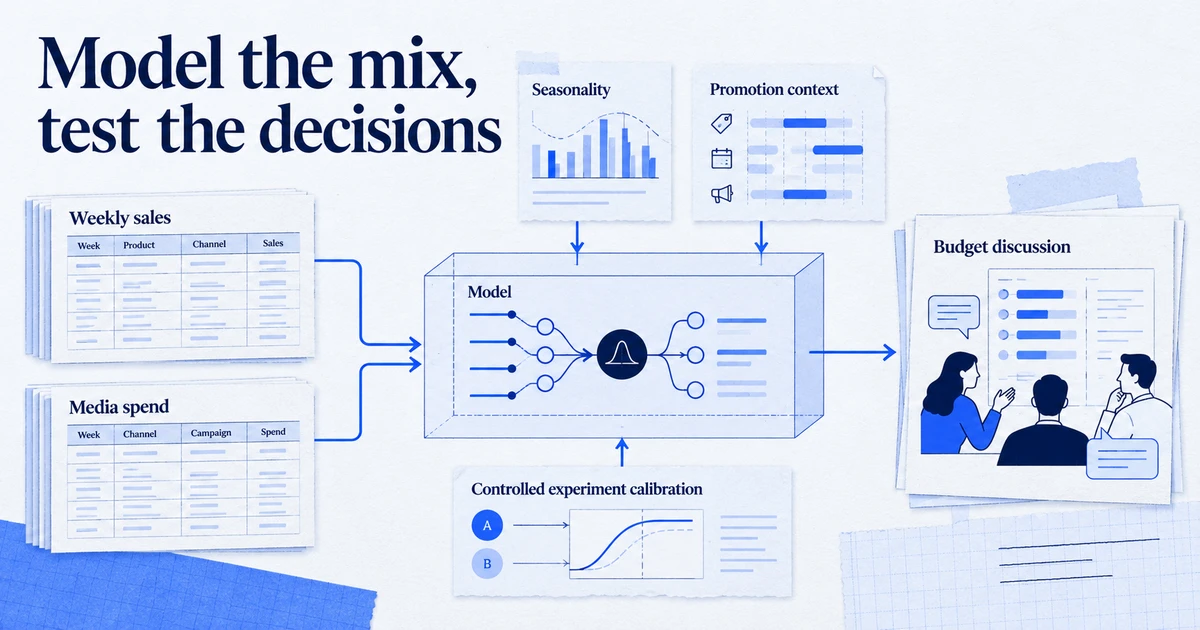
Marketing mix modelling (MMM) is a statistical method that estimates how much each marketing channel and other factors, such as price, seasonality and promotions, contributed to sales or another KPI, using aggregated time-series data rather than user-level tracking. It is used to measure return on investment by channel and to plan budget allocation.
Marketing mix modelling is older than digital analytics: it was built to answer how much TV, print and price promotions each added to sales. It has come back because it needs no cookies, no user IDs and no consent to track individuals, only aggregated numbers you already have.
How it works
An MMM is a regression model, usually on weekly data, that explains a KPI such as revenue from:
- Media inputs per channel: spend, impressions, or reach and frequency.
- Control variables: price, promotions, distribution, seasonality, holidays, competitor activity, macro factors.
- A baseline: sales that would happen with no marketing.
Two transformations make it describe marketing realistically:
- Adstock (carryover). The effect of this week's spend continues into following weeks, at a decaying rate.
- Saturation (diminishing returns). Each extra euro in a channel adds less than the one before, following a response curve.
The fitted model gives each channel's contribution, ROI and marginal ROI, and a budget optimiser can then propose a better allocation for the same total spend.
Two open-source frameworks are widely used:
| Framework | Maintainer | Approach |
|---|---|---|
| Meridian | Python, Bayesian causal inference, geo-level or national data, calibration with experiments and priors, reach and frequency modelling | |
| Robyn | Meta Marketing Science | R (Python beta), ridge regression, multi-objective evolutionary hyperparameter optimisation, time-series decomposition |
Google announced the general availability of Meridian in January 2025. In 2026 it added Scenario Planner, a no-code interface for working with a trained model, and GeoX, a toolkit for designing geo experiments whose results can calibrate the model.
Why it matters in 2026
User-level tracking covers less of the customer journey each year, and it never covered offline media well. MMM measures every channel on the same footing, from search to podcasts, and is not affected by consent rates or cookie limits.
Its weakness is that it is a model. Channels whose spend always moves together are hard to separate, and results depend on choices about priors, adstock and saturation. That is why current practice calibrates MMM with incrementality tests, and uses attribution for day-to-day optimisation within channels.
How to check it
When you review an MMM, look at:
- Fit and holdout accuracy. Does the model predict weeks it was not trained on?
- Plausibility. Are ROIs and carryover lengths within a sensible range for each channel? A channel with a negative or extreme effect needs an explanation.
- Uncertainty. Bayesian models such as Meridian give intervals; wide intervals mean the data cannot separate that channel.
- Calibration. Do results agree with any lift tests you have run?
- Data quality. Spend and impressions must be complete and consistent per channel and week. Exports from Google Ads, Meta and BigQuery often need cleaning first.
Common mistakes
- Too little variation. Constant spend gives the model nothing to learn from.
- Missing controls. Leaving out promotions or price changes credits their effect to media.
- Mixing up spend and impressions across channels without reason.
- Treating the optimiser as a plan. Recommended shifts far outside past spend ranges are extrapolation.
- Running it once. Models need refreshing as the mix and market change.
Related terms: incrementality, attribution model.
Frequently asked questions
Does marketing mix modelling need cookies or user-level data?
No. MMM works on aggregated data such as weekly spend, impressions and sales by channel and region. Google's Meridian documentation describes MMM as privacy-safe because it does not use cookie or user-level information.
What are Meridian and Robyn?
Both are open-source MMM frameworks. Meridian is Google's Python framework based on Bayesian causal inference, which supports geo-level data, calibration with experiments and reach and frequency data. Robyn is Meta Marketing Science's R package, with a beta Python version, which uses ridge regression and evolutionary hyperparameter optimisation.
How much data do I need for marketing mix modelling?
There is no single threshold. You need enough history to see spend vary independently across channels and seasons, which in practice often means two years or more of weekly data, and enough variation in spend. Geo-level data increases the number of observations and is encouraged by Meridian where available.
How is MMM different from attribution?
Attribution assigns credit to individual tracked touchpoints before a conversion. MMM estimates channel effects statistically from aggregated totals, including channels that cannot be tracked at user level, such as TV or out-of-home. They answer different questions and are often used together.
Sources
Dimitris builds Tracking Whisper and writes about tracking, analytics and data from the work the agent does every day: GTM containers, GA4 properties, ad platforms and the numbers in between.