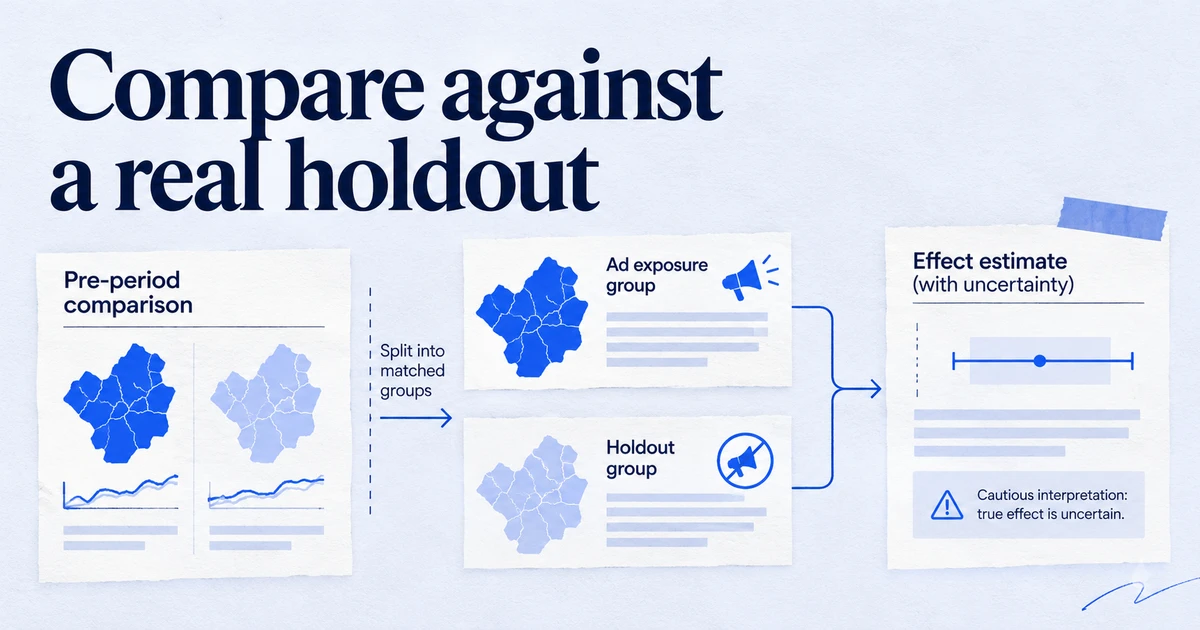
Incrementality is the share of conversions, revenue or other outcomes that happened because of a marketing activity and would not have happened without it. It is measured by comparing a group exposed to the activity with a comparable control group that was not, for example in a conversion lift or geo experiment.
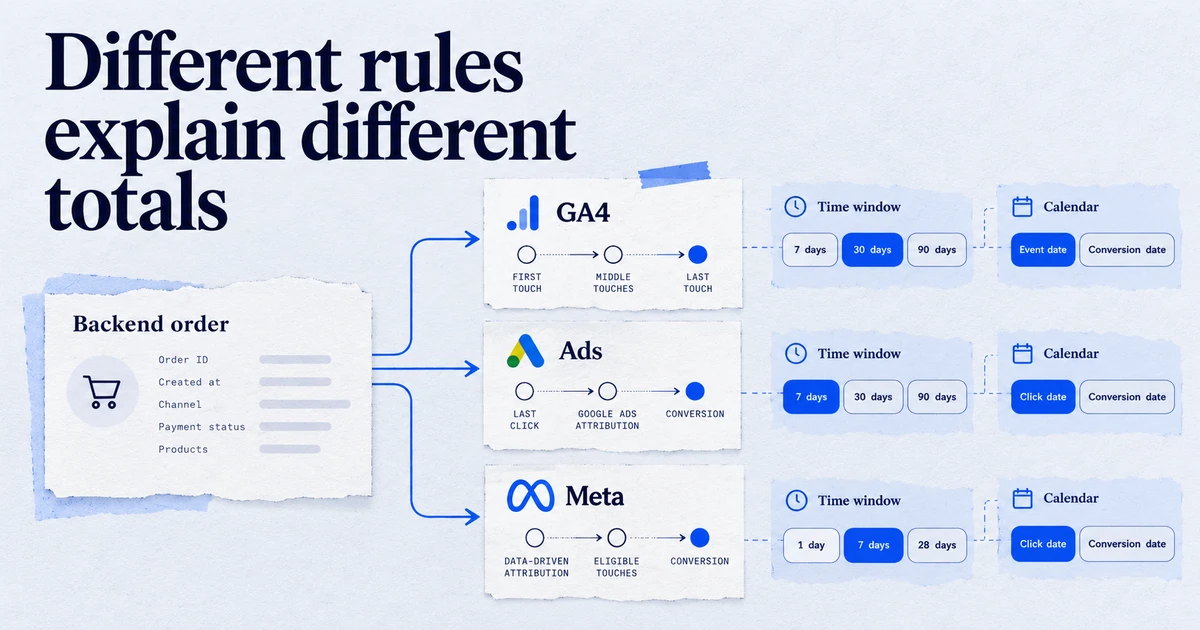
Every ad platform reports the conversions it can link to its ads. None of those reports says how many of the buyers would have bought anyway. Incrementality is the answer to that second question, and it can only be measured by holding something back.
How it works
An incrementality test compares two groups that are alike except for exposure to the marketing activity:
- Test group: can see the ads, or the region where the campaign runs.
- Control group: does not see the ads, or the region where the campaign is paused.
The difference in conversions between the two is the incremental effect:
| Measure | Calculation |
|---|---|
| Incremental conversions | Test conversions minus expected conversions without ads (from the control) |
| Relative lift | Incremental conversions divided by the control-based baseline |
| Incremental cost per conversion | Spend divided by incremental conversions |
| Incremental ROAS | Incremental revenue divided by spend |
There are two common designs:
- User-level holdout. The platform randomly withholds ads from part of the audience. Google Ads Conversion Lift based on users and Meta Conversion Lift tests work this way.
- Geo experiment. Regions are split into test and control groups. Google Ads Conversion Lift based on geography aggregates conversions into non-overlapping regions and supports offline data; Google notes it usually needs a higher budget than the user-based version. You can also run geo tests yourself with your own sales data.
Why it matters in 2026
Attribution has more gaps than it used to: consent choices, cookie restrictions and modelled conversions all mean platform numbers are partly estimates. Each platform also tends to credit itself. Incrementality tests are the most direct way to check whether a channel's reported results hold up.
They also calibrate other methods. Marketing mix modelling tools such as Google's Meridian can take lift test results as prior information, and in 2026 Google released GeoX, a geo-experiment toolkit within Meridian, for designing and analysing such tests.
How to check it
When you read a lift result, check:
- Was the split random and the control clean? Control users or regions should not have received the same campaign through another route.
- Is the result significant? Look at the confidence or credible interval, not only the point estimate. An interval that includes zero means no detectable lift.
- Did the test cover the conversion delay? Short tests miss late conversions.
- Is the conversion data complete for both groups? Use the same source, ideally your own backend data, for test and control.
- Does it change a decision? Compare incremental cost per conversion with the platform-reported figure and with your target.
Common mistakes
- Reading platform-attributed numbers as incremental. They answer different questions.
- Tests that are too small. Low volumes produce wide intervals that cannot detect realistic effects.
- Changing the campaign mid-test. Budget or creative changes muddy the comparison.
- Contaminated geo splits. Neighbouring regions share media markets or delivery areas.
- One test treated as permanent truth. Incrementality changes with season, spend level and creative.
Related terms: attribution model, Conversions API, enhanced conversions.
Frequently asked questions
How is incrementality different from attribution?
Attribution shares out credit for conversions the platforms recorded, based on the touchpoints they saw. Incrementality measures how many of those conversions the activity actually caused, by comparing with a control group. A campaign can have high attributed revenue and low incrementality if it mostly reaches people who would have bought anyway.
What is a conversion lift study?
A conversion lift study is a platform-run experiment that splits an audience or set of regions into a test group that can see the ads and a control group that cannot, then compares conversions. Google Ads offers Conversion Lift based on users and based on geography, and Meta offers Conversion Lift tests through its Experiments tools.
Can I measure incrementality without a platform lift study?
Yes. A geo experiment, where you switch a channel off or change spend in some regions and compare them with similar regions, can be run with your own sales data. It needs enough regions and conversions, a pre-test period to check the regions move together, and a plan written before the test starts.
How long should an incrementality test run?
Long enough to collect the conversions the power calculation calls for and to cover the usual delay between ad exposure and purchase. Google's Meridian GeoX documentation suggests about 7 to 14 weeks from pre-test planning to completed analysis for a geo test, but the right length depends on your volumes.
Sources
Dimitris builds Tracking Whisper and writes about tracking, analytics and data from the work the agent does every day: GTM containers, GA4 properties, ad platforms and the numbers in between.