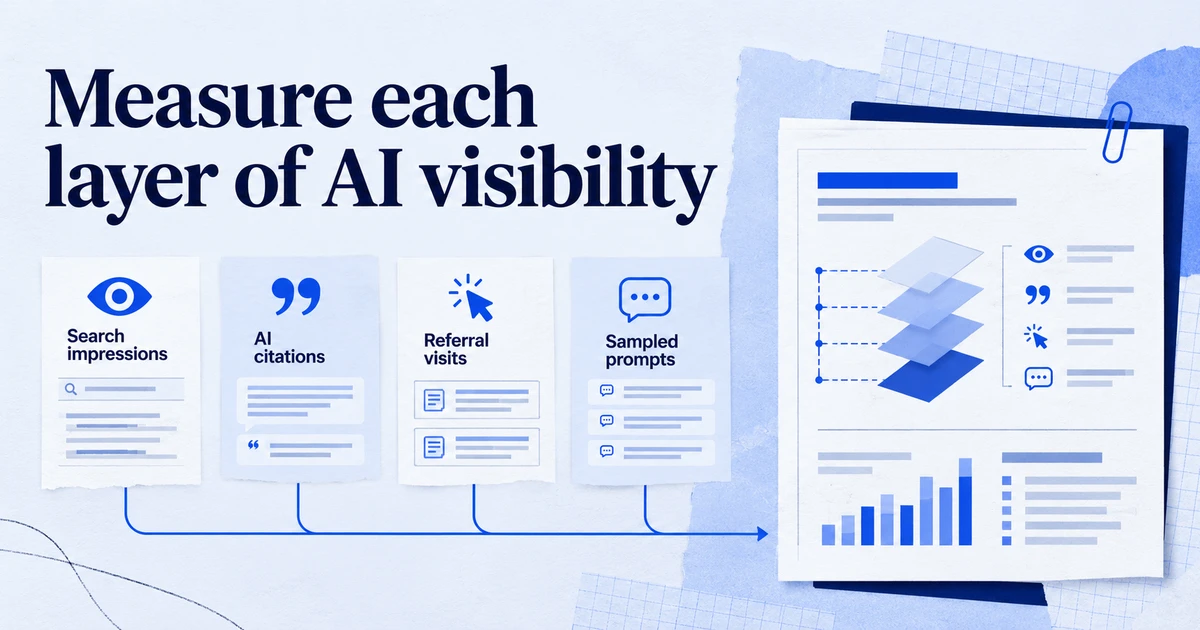
GEO is mostly SEO aimed at a different result: being cited inside an AI answer rather than ranked in a list, and Google says its own AI features run on the same ranking systems. The difference is measurement. You track AI visibility with four layers: AI impressions from Search Console, citations and citation share from Bing Webmaster Tools, AI referral sessions in GA4, and a fixed prompt panel you sample yourself for assistants that publish no data.
Generative engine optimisation, or GEO, has become the label for trying to appear in answers from ChatGPT, Gemini, Copilot, Perplexity and Google's AI Overviews. The debate about whether it is a new discipline or SEO under a new name generates more heat than measurement. This article takes a practical line: most of the work overlaps, the metrics do not, and in 2026 there is finally enough first-party data to measure AI visibility properly. Here is how to build that measurement.
Where does the term GEO come from?
The term was introduced in the paper "GEO: Generative Engine Optimization" by Pranjal Aggarwal and colleagues, first posted on arXiv in November 2023 and accepted at KDD 2024. The authors define generative engines as search systems that use large language models to gather and summarise sources into one answer. They proposed visibility metrics for how prominently a source appears in such answers, and a benchmark, GEO-bench, to test content changes against them.
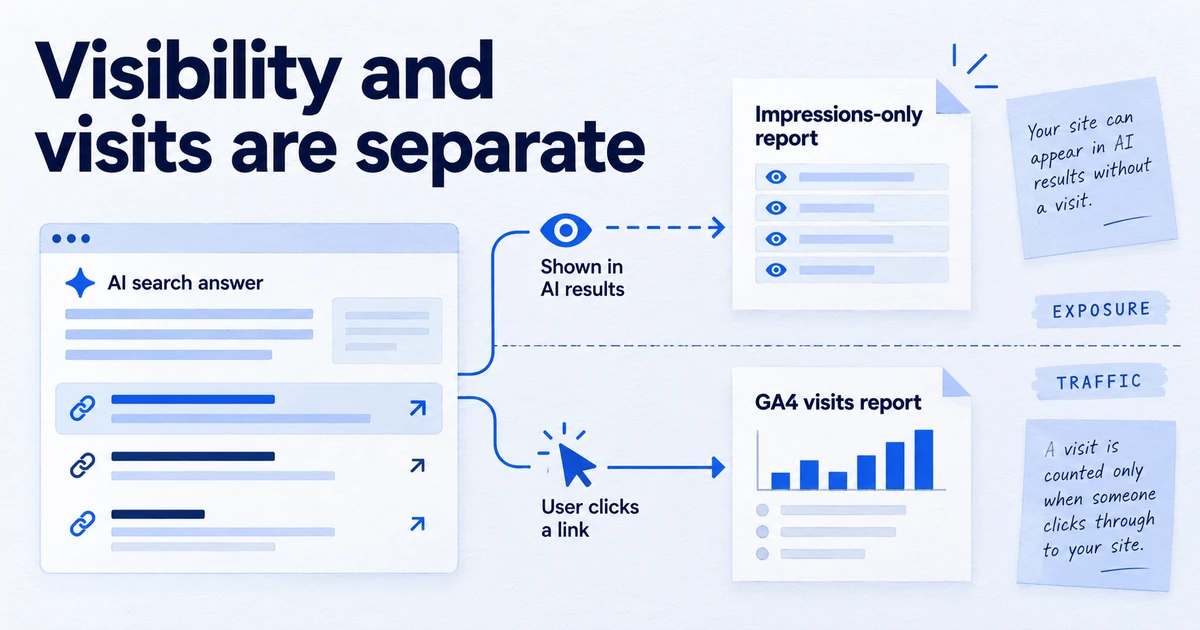
The useful idea for marketers is the shift in what "visibility" means. In a results page you are ranked. In an AI answer you are cited, paraphrased, or absent. A citation can bring attention without any visit to your site.
Is GEO different from SEO?
For Google, the answer is published. Google's guide to optimising for generative AI features states that its AI features are rooted in the core Search ranking and quality systems, and that optimising for generative AI search is, from Google's perspective, still SEO. The "AI features and your website" page adds that there are no additional technical requirements to appear in AI Overviews or AI Mode: a page must be indexed and eligible to show with a snippet. Google's guide also says Google Search ignores llms.txt files, and that tactics like artificial "chunking" or chasing inauthentic mentions can be ignored.
Other platforms run their own retrieval. OpenAI documents that ChatGPT search uses the OAI-SearchBot crawler, and that sites which block it in robots.txt will not be shown in ChatGPT search answers, though they can still appear as navigational links. Blocking GPTBot, the training crawler, is a separate decision with no effect on search.
So the work overlaps heavily. The measurement does not.
| Question | SEO measures | GEO measures |
|---|---|---|
| Were we seen? | Impressions, rankings | AI impressions, citations |
| Against whom? | Share of top positions | Citation share per query |
| Did it bring visits? | Organic clicks and sessions | AI referral sessions |
| Did it matter without a visit? | Rarely asked | Mentions and citations with no click |
What are the four layers of AI visibility data?
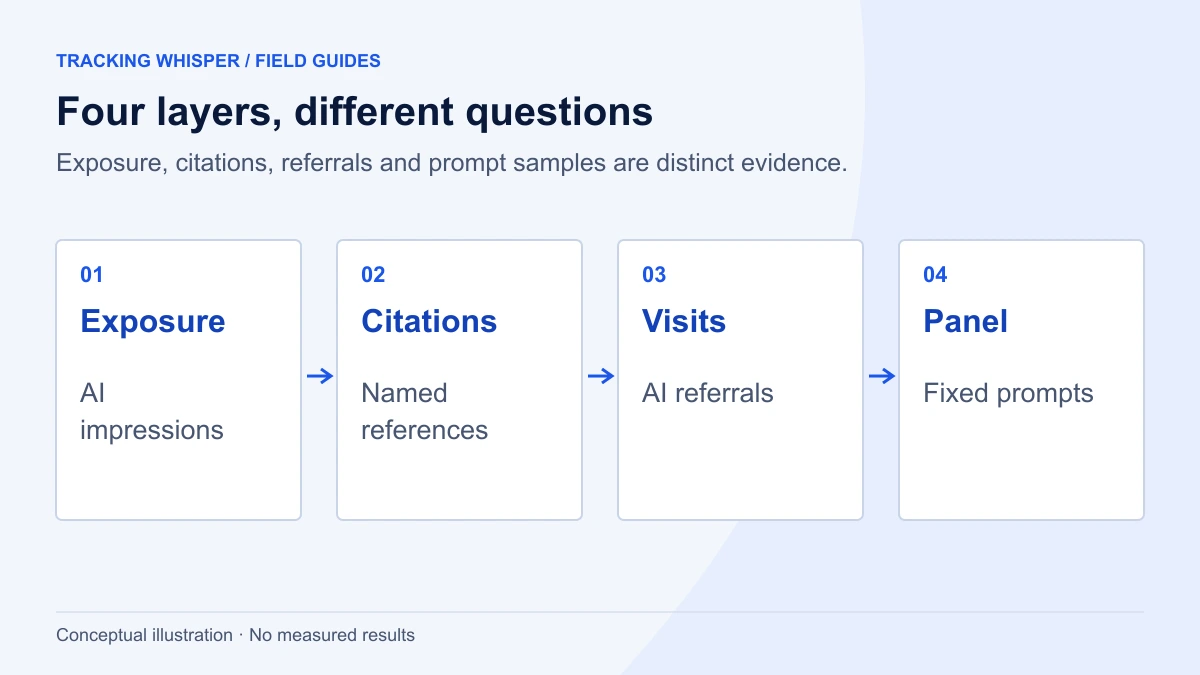
No single source covers every assistant. In October 2026 the honest setup has four layers, each from a different place.
1. AI impressions from Search Console. Since June 2026, Search Console has generative AI performance reports that count how often your pages were shown in AI Overviews and AI Mode, plus AI features in Discover. They report impressions by page, country, device and date, with no clicks or queries. We cover reading them in Search Console's generative AI report.
2. Citations from Bing Webmaster Tools. Microsoft launched AI Performance in Bing Webmaster Tools as a public preview in February 2026. It shows when your site is cited in AI-generated answers across Microsoft Copilot, AI summaries in Bing and select partner integrations. It reports Total Citations, Average Cited Pages per day, page-level citation counts and grounding queries, the phrases the AI used when retrieving the content it cited. Microsoft notes the data is a sample of overall citation activity.
3. AI referral sessions in GA4. Since May 2026, GA4's Default Channel Group includes an AI Assistant channel for sessions referred by recognised assistants, while AI Overviews and AI Mode clicks stay in Organic Search. See GA4's AI Assistant channel for the gaps.
4. A prompt panel you run yourself. For ChatGPT, Claude, Perplexity and the Gemini app, no publisher report exists. You sample them directly with a fixed set of prompts, described below.
What is citation share, and how do you measure it?
In June 2026 Bing added four preview features to AI Performance: Intents, Topics, Citation Share and Compare. Microsoft defines citation share as the percentage of citations attributed to your site out of all citations shown across all sites for the same grounding query. Intents classify grounding queries (for example Informational, Commercial, Navigational), Topics group them into themes, and Compare overlays a previous period.
That definition is worth adopting for every assistant, because it is the closest equivalent to share of voice. Where no platform reports it, you calculate it from your own prompt panel:
Citation share for a prompt set = citations to your domain ÷ all citations recorded for those prompts, over the same runs.
Keep the denominator honest. Count every cited domain, not only the competitors you track, or your share will look larger than it is.
How do you build a prompt panel?
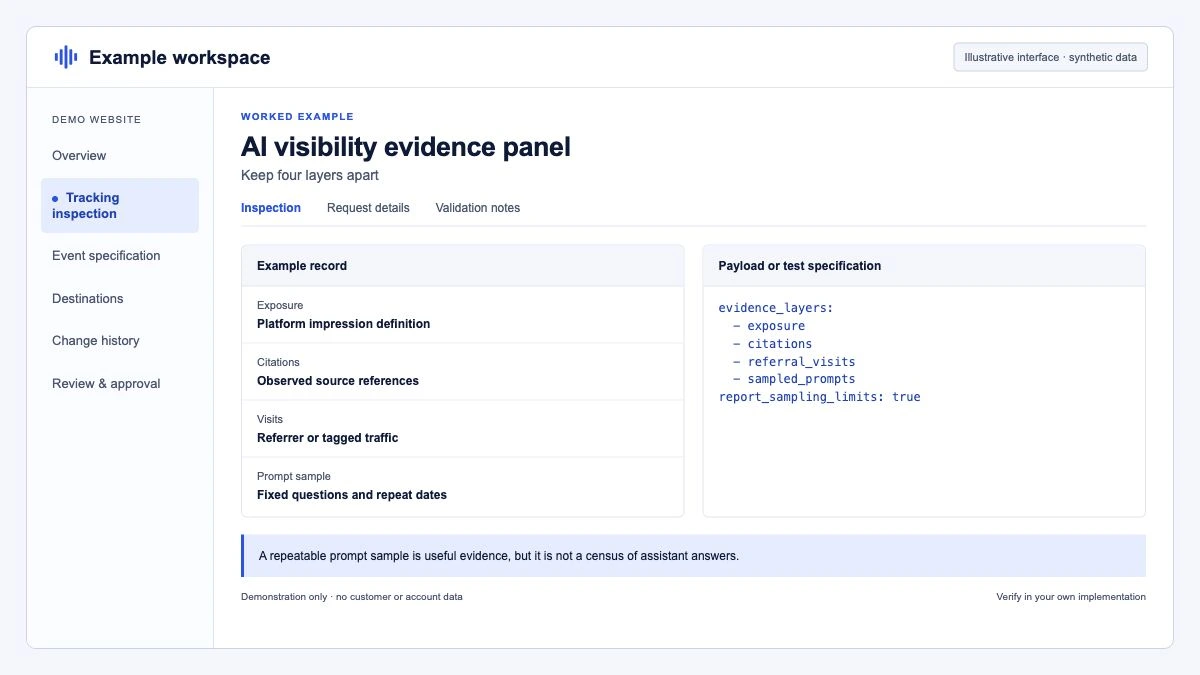
A prompt panel is a fixed list of questions your buyers ask, run on a schedule against each assistant, with the cited sources recorded.
- Write 40 to 100 prompts grouped by topic and funnel stage. Take them from Search Console queries, Bing grounding queries, sales call notes and support tickets. Phrase them the way a person would ask an assistant, not as keywords.
- Fix the conditions. Use a logged-out or clean account where possible, one country and one language per panel, and note the model or mode used. Answers vary by account, location and time, so consistency matters more than realism.
- Run each prompt several times per cycle, for example three runs, because the same prompt can produce different citations. Record each run separately.
- Record the evidence: date, assistant, prompt ID, run number, each cited URL and whether your brand was mentioned without a link.
- Run monthly. Weekly runs mostly measure noise; quarterly runs miss changes.
- Freeze the list for at least a quarter. Changing prompts resets your trend line. Add new prompts as a separate group.
Store the results in a table, and the calculation is a simple query. This BigQuery example assumes one row per citation:
-- Table: geo_panel.citations
-- Columns: run_date DATE, assistant STRING, prompt_id STRING, topic STRING,
--          run_no INT64, cited_domain STRING
SELECT
  FORMAT_DATE('%Y-%m', run_date) AS month,
  assistant,
  topic,
  COUNT(*) AS all_citations,
  COUNTIF(cited_domain = 'example.com') AS our_citations,
  ROUND(SAFE_DIVIDE(COUNTIF(cited_domain = 'example.com'), COUNT(*)), 3) AS citation_share,
  COUNT(DISTINCT IF(cited_domain = 'example.com', CONCAT(prompt_id, '-', CAST(run_no AS STRING)), NULL))
    / COUNT(DISTINCT CONCAT(prompt_id, '-', CAST(run_no AS STRING))) AS answer_presence
FROM `my-project.geo_panel.citations`
WHERE run_date >= DATE_SUB(CURRENT_DATE(), INTERVAL 6 MONTH)
GROUP BY month, assistant, topic
ORDER BY month, assistant, citation_share DESC;
citation_share is your share of all citations. answer_presence is the share of answers that cite you at least once, which is often the easier number to explain to a client.
What can server logs add?
Crawler visits are an input signal, not an outcome. If OAI-SearchBot never fetches a page, ChatGPT search is unlikely to cite it. A monthly count of AI crawler requests by path tells you whether your key pages are being fetched at all. On a standard combined log format, this is enough:
grep -E "OAI-SearchBot|ChatGPT-User|bingbot" access.log \
  | awk '{print $7}' \
  | sort | uniq -c | sort -rn | head -50
OpenAI describes ChatGPT-User as acting on user requests rather than crawling automatically, so its hits are closer to live demand than OAI-SearchBot's. Verify user agents against the IP ranges each provider publishes before you trust the counts, because user-agent strings are easy to fake.
How should you report AI visibility?
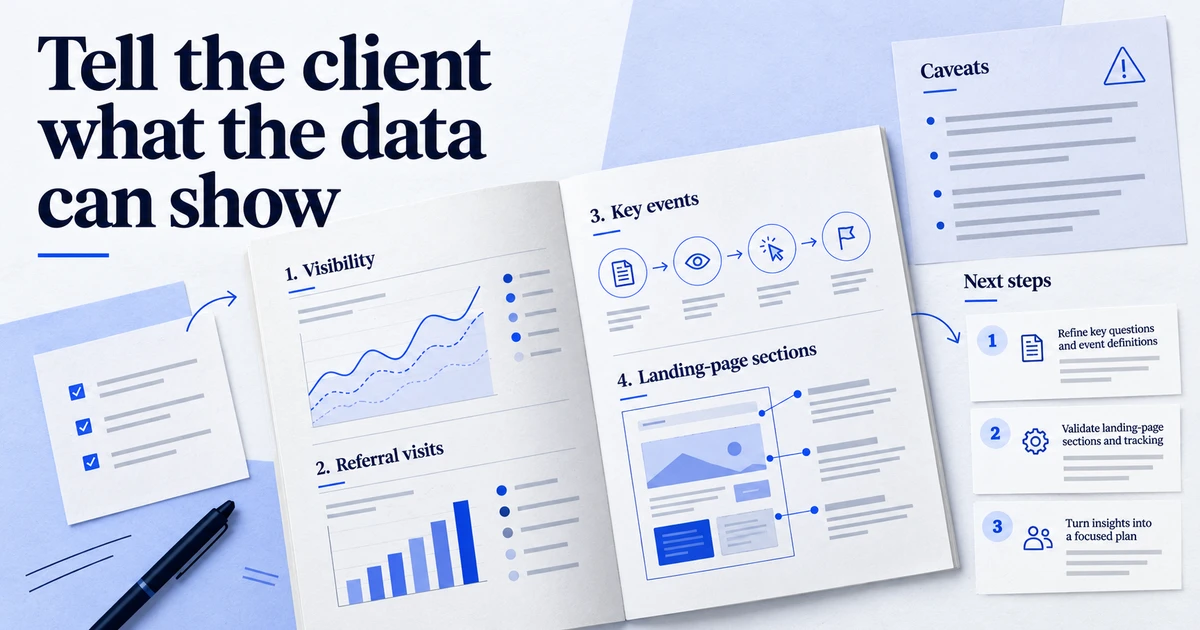
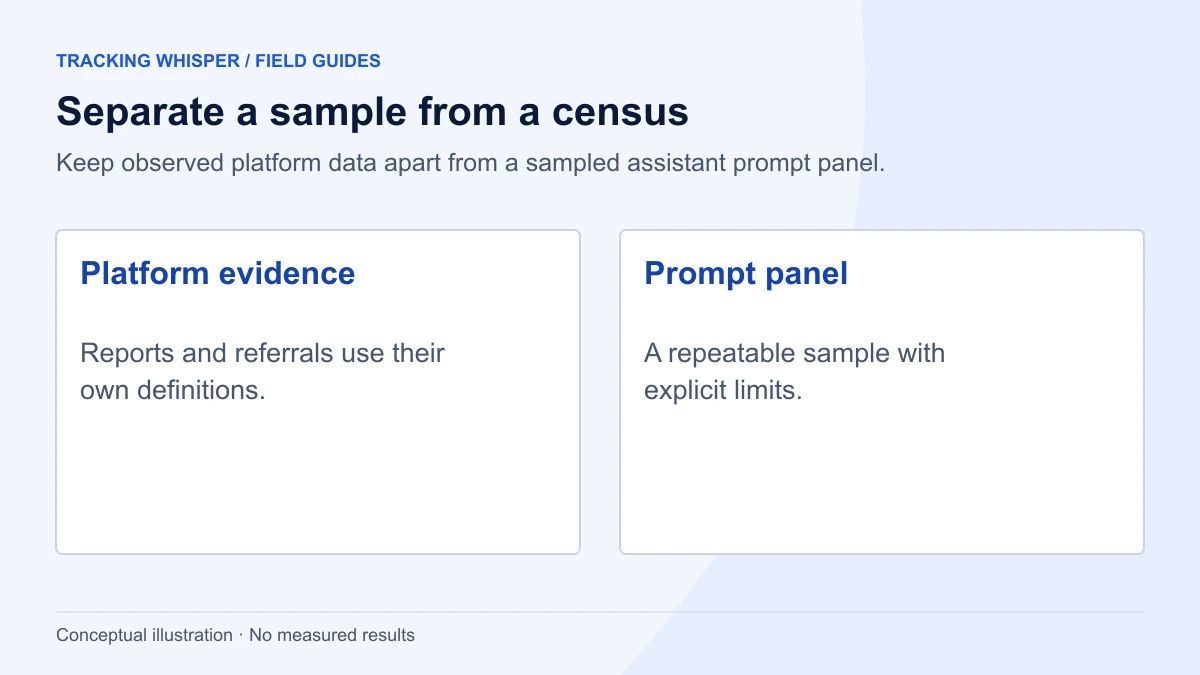
Report each layer separately, side by side, and resist a single blended "AI visibility score". A composite hides which input moved, and the inputs move for very different reasons.
| Layer | Metric | Source | Cadence |
|---|---|---|---|
| Google AI features | AI impressions, AI impression share by page | Search Console | Monthly |
| Microsoft AI answers | Citations, cited pages, citation share by query | Bing Webmaster Tools | Monthly |
| Visits from assistants | Sessions, engaged sessions, key events | GA4 AI Assistant channel | Monthly |
| Other assistants | Citation share, answer presence | Your prompt panel | Monthly |
Add a short note on method each month: which prompts, how many runs, which assistants. If someone asks why a number changed, the method note is usually where the answer starts. For a ready layout aimed at clients, see Reporting AI traffic to clients, and for the vocabulary, our glossary entry on generative engine optimization.
Key takeaways
- GEO and SEO share most of the work; Google says optimising for its AI features is still SEO and that it ignores
llms.txt. - The difference is the outcome: a citation inside an answer, which can create visibility without a click.
- First-party data now covers part of the picture: Search Console AI impressions (since June 2026) and Bing citations and citation share (preview since February and June 2026).
- For ChatGPT, Claude, Perplexity and the Gemini app, run a fixed monthly prompt panel and calculate citation share and answer presence yourself.
- Report each layer separately with a method note, rather than one blended score.
Tracking Whisper connects to Search Console, GA4 and BigQuery, so the Google layers and a prompt-panel table stored in BigQuery can sit in one monthly report; the Bing data and the panel runs themselves still come from your own exports.
Frequently asked questions
What is citation share in AI search?
Citation share is the percentage of all citations shown for a query that point to your site. Bing Webmaster Tools reports it per grounding query in its AI Performance report, a preview feature added in June 2026. For assistants without such a report, you estimate it by sampling a fixed set of prompts and counting which domains are cited.
Is GEO different from SEO?
Largely no for the work, yes for the measurement. Google states that its generative AI features are rooted in its core ranking and quality systems and that optimising for them is still SEO. What changes is the result you measure: citation in an answer, which can deliver visibility without a click.
Does llms.txt help visibility in AI Overviews?
Not in Google Search. Google's guide to optimising for generative AI features says Google Search ignores llms.txt and that the file neither helps nor harms visibility. Other platforms make their own decisions, and none of the sources checked for this article confirm a benefit.
How do I see whether ChatGPT cites my site?
OpenAI does not offer a publisher report, so use two signals. ChatGPT search adds utm_source=chatgpt.com to links, which shows clicks in GA4, and a prompt panel run on a fixed schedule shows citations that did not produce a click. Make sure robots.txt does not block OAI-SearchBot, or your pages will not be shown in ChatGPT search answers.
Which AI visibility metric should I report to a client?
Report one metric per layer and do not blend them: AI impressions from Search Console, citations from Bing, AI assistant sessions and key events from GA4, and citation share from your own prompt panel. Each answers a different question, and a single composite score hides which part moved.
Sources
- GEO: Generative Engine Optimization (Aggarwal et al.), arXiv
- Google's guide to optimizing for generative AI features on Google Search, Google Search Central
- AI features and your website, Google Search Central
- Introducing Search Generative AI performance reports in Search Console, Google Search Central Blog
- Introducing AI Performance in Bing Webmaster Tools Public Preview, Bing Webmaster Blog
- New AI Visibility Insights in Bing Webmaster Tools: Intents, Topics, Citation Share, Compare, Bing Blogs
- Overview of OpenAI crawlers, OpenAI
- [GA4] Default channel group, Analytics Help
Dimitris builds Tracking Whisper and writes about tracking, analytics and data from the work the agent does every day: GTM containers, GA4 properties, ad platforms and the numbers in between.