Generative engine optimisation (GEO) is the practice of making content more likely to be used and cited as a source in answers produced by generative AI systems, such as ChatGPT, Gemini, Claude, Perplexity and Google's AI Overviews and AI Mode. The term comes from a 2023 research paper by Aggarwal and colleagues, presented at KDD 2024.
More questions now end with an AI-written answer rather than a list of links. The answer may cite a handful of sources, or none. Generative engine optimisation is the work of being one of those sources, and of measuring whether you are.
How it works
Generative engines answer a question in two broad steps: they retrieve documents relevant to the query, then a language model writes a response that draws on, and often cites, some of them. Google describes its AI Overviews and AI Mode as using a "query fan-out" technique, issuing several related searches across subtopics to build the answer, which can surface a wider set of pages than a classic results page.
GEO therefore has two layers:
- Be retrievable. The page must be crawlable, indexable and relevant to the many sub-questions an engine may search for. This is ordinary technical and content SEO.
- Be quotable. Once retrieved, the content should make it easy for the model to lift a precise, self-contained statement: a clear definition, a specific number with its source, a step-by-step procedure.
The original GEO paper tested methods such as adding statistics, adding quotations and citing sources, and found that effects varied by domain. Its headline figure, a visibility increase of up to 40%, was measured on its own benchmark and engines, not on any specific commercial assistant.
Why it matters in 2026
Two measurement changes this year made GEO trackable in standard tools:
- GA4 AI Assistant channel. GA4 added an AI Assistant channel to the Default Channel Group in 2026. Sessions referred by recognised assistants get the medium
ai-assistant. Google's AI Overviews and AI Mode are not included. See GA4's AI Assistant channel. - Search Console generative AI reports. Google introduced reports for impressions in AI Overviews, AI Mode and Discover's generative features in June 2026, rolled out gradually and without click or query data at launch. See Search Console's generative AI report.
Google's own guidance for its AI features is that no special markup or separate optimisation is required beyond existing Search best practices, which is a useful check on claims that GEO needs entirely new tactics.
How to check it
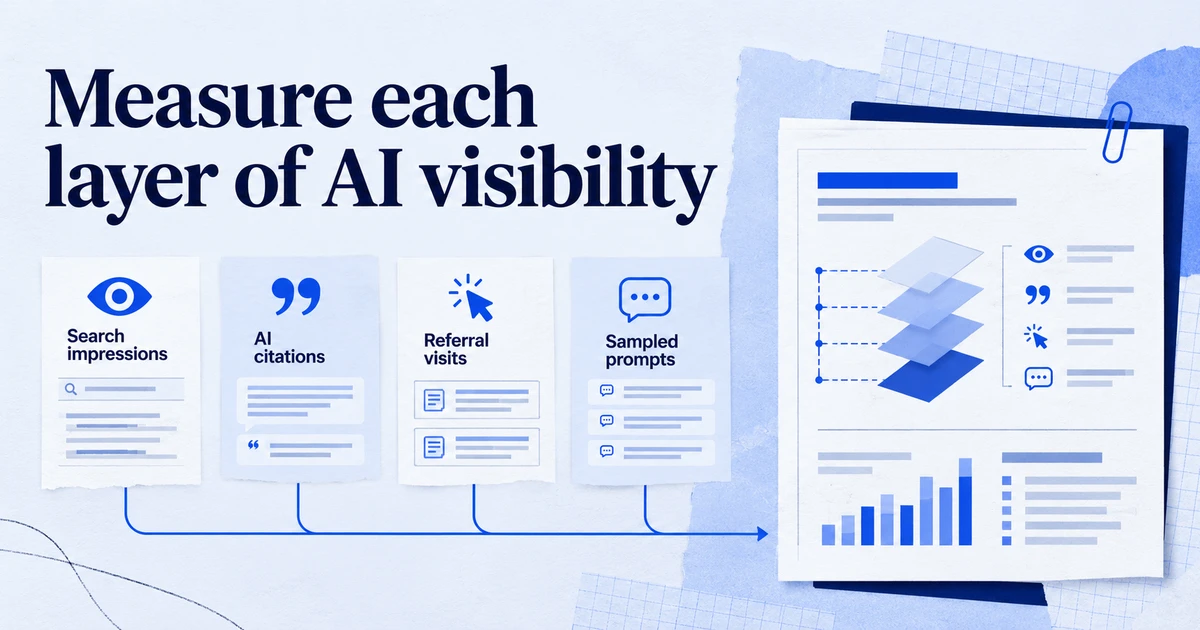
- In GA4, report sessions, key events and revenue for the AI Assistant channel, and break it down by session source to see which assistants send traffic.
- In Search Console, if the generative AI report is available for your property, track AI feature impressions by page.
- Keep a fixed list of questions your buyers ask, run them in the main assistants on a regular schedule, and record whether and how your site is cited. Note the date and engine, as answers change.
- Compare the pages that earn citations with those that do not: definitions, data, structure and freshness.
Common mistakes
- Treating GEO as separate from SEO. Pages that are not indexed or ranked rarely get cited.
- Chasing a single score. Assistant answers vary by run, location and wording; track trends over many prompts.
- Expecting AI Overviews in the AI Assistant channel. That traffic is counted as Google organic.
- Unsupported claims. Statistics without a source are less useful to an engine and to readers.
- Writing for models instead of people. Content that reads badly to humans does not earn links or trust.
Related terms: attribution model, incrementality.
Frequently asked questions
Is GEO different from SEO?
It overlaps heavily. Generative search features still rely on retrieving and ranking web pages, and Google says the same SEO best practices apply to its AI features. GEO adds a focus on being quoted or cited inside an AI answer, and on measuring that visibility, rather than only on ranking a blue link.
Where did the term generative engine optimisation come from?
From the paper 'GEO: Generative Engine Optimization' by Pranjal Aggarwal, Vishvak Murahari, Tanmay Rajpurohit, Ashwin Kalyan, Karthik Narasimhan and Ameet Deshpande, first published in November 2023 and presented at KDD 2024. It introduced a benchmark, GEO-bench, and reported that some content changes could raise source visibility in generative engine responses by up to 40%.
How can I measure traffic from AI assistants in GA4?
Since 2026, GA4's Default Channel Group includes an AI Assistant channel for sessions referred by recognised assistants such as ChatGPT, Gemini and Claude, with the medium set to ai-assistant. It does not include Google's AI Overviews or AI Mode, which arrive as Google organic traffic.
Does Search Console report AI Overviews visibility?
Google introduced Search Generative AI performance reports in Search Console in June 2026, showing impressions in generative AI features such as AI Overviews and AI Mode, by page, country, device and date. Google rolled them out to a subset of sites first, and at launch they did not include clicks or query data.
Sources
Dimitris builds Tracking Whisper and writes about tracking, analytics and data from the work the agent does every day: GTM containers, GA4 properties, ad platforms and the numbers in between.